



A roof in Southwestern Pennsylvania has to do more than look good from the driveway. It has to handle heavy rain, snow, freeze-thaw cycles, wind, and the kind of seasonal wear that exposes cheap materials fast. When homeowners and property owners ask about metal roofing vs shingles, they are usually trying to answer a practical question: what will hold up best for the money on this specific building?
The honest answer is that both can be the right choice. It depends on your budget, how long you plan to keep the property, the look you want, and how the building is used. A farmhouse, a detached garage, a rental house, and a small commercial building may all need different answers.
Metal roofing vs shingles: the biggest difference
The biggest difference is simple. Asphalt shingles usually cost less upfront, while metal roofing typically lasts longer and can offer better long-term value. That does not automatically make metal the better roof for every project, and it does not mean shingles are a compromise. A properly installed shingle roof from a trusted brand can serve a home well for many years.
Where people get into trouble is choosing only by sticker price or only by lifespan. A lower upfront cost matters if you need a roof now and want to protect your home without stretching the budget. On the other hand, if you plan to stay put for decades, it makes sense to look closely at whether paying more now could save you from another replacement later.
Upfront cost and long-term value
For many property owners, budget is the starting point. Shingles generally win on initial cost. Materials and installation are usually more affordable than metal, which is why asphalt remains one of the most common residential roofing choices.
That matters right now, especially if you are replacing a worn roof after storm damage or age and need a practical solution. It also matters if you own multiple buildings and need to control project costs across a home, garage, barn, or rental property. For customers looking at shingles, current promotions can make the math even better. Tri County Building Supplier is currently offering 30% off Owens Corning shingles, which can make a new shingle roof especially attractive for property owners who want quality without paying Pittsburgh-area markup.
Metal roofing usually costs more upfront, but it often pays back over time through a longer service life and less frequent replacement. If you are roofing your forever home, a commercial building, or an agricultural structure you expect to use for decades, that longer horizon can shift the value equation.
Lifespan in real-world conditions
This is where metal often stands out. A quality metal roof can last significantly longer than a standard shingle roof, especially when it is matched to the building and installed correctly. That longer life is one reason metal is popular on barns, workshops, garages, and homes where owners want a low-hassle roof for the long haul.
Shingles still offer solid performance, especially when you choose a reputable product line and keep up with maintenance. But asphalt is more vulnerable to aging over time. Sun exposure, granule loss, wind damage, and repeated freeze-thaw cycles can shorten roof life, particularly if ventilation or installation was not right from the start.
In this region, weather is not theoretical. Snow loads, ice, and moisture are part of the job description for any roof. That is why product quality and installation quality matter just as much as material type.
Maintenance and repairs
If you want a roof with less routine attention, metal often has the edge. It is resistant to many of the problems that wear shingles down over time. That said, metal is not maintenance-free. Fasteners, seams, flashing, and trim still need to be right, and repairs should be handled by someone who understands the system.
Shingle roofs are familiar to most homeowners, and repairs can be straightforward when damage is limited to a small area. If a few shingles are blown off in a storm, replacing them may be relatively simple. But shingles can also develop issues gradually, and those small warning signs are easy to miss until leaks show up inside.
The key with either system is not to wait too long. Minor roof problems are almost always cheaper to address than water damage, deck rot, insulation issues, or interior repairs.
Appearance and curb appeal
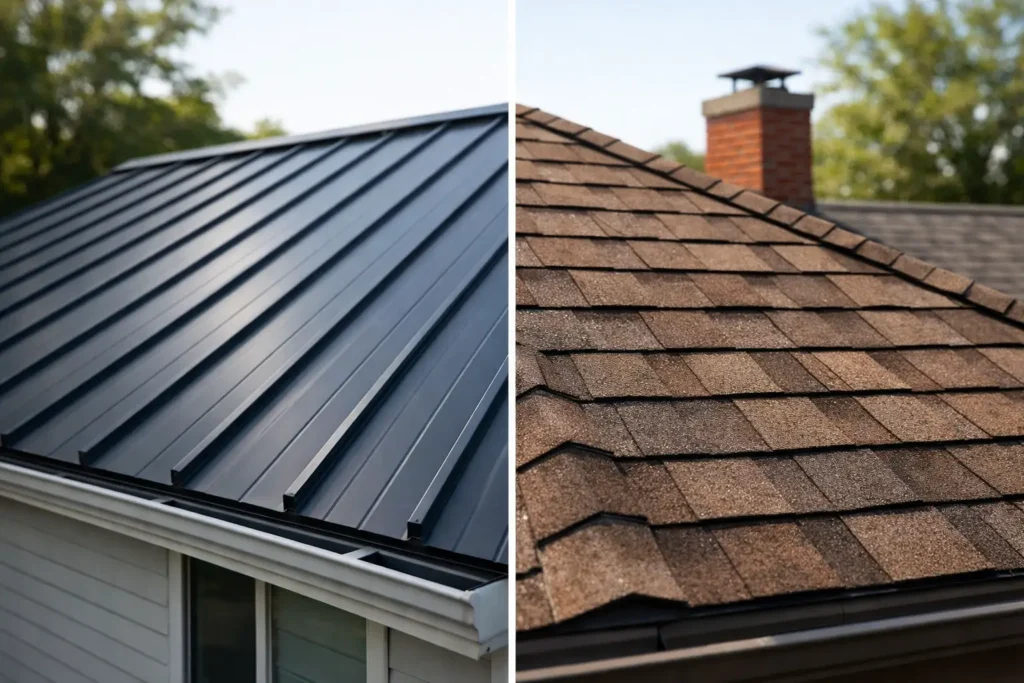
A roof changes the look of a building more than most people expect. Shingles tend to offer a traditional residential appearance that works well on many homes in established neighborhoods and rural communities. They come in a wide range of colors and styles, which gives homeowners flexibility without making the house look out of place.
Metal roofing has a cleaner, sharper appearance that can feel more modern on some homes and more practical on others. It is also a natural fit for barns, pole buildings, garages, barndominiums, and many commercial or agricultural structures. Some property owners choose metal because they like the look. Others choose it because it matches the building type better.
This is one of those areas where there is no universal winner. The right appearance depends on the style of the building, nearby structures, neighborhood expectations, and your own preference.
How each roof handles Southwestern Pennsylvania weather
Regional conditions matter. In Southwestern Pennsylvania, roofs take a beating from wet weather, winter storms, and temperature swings. That is one reason local guidance matters more than a generic online answer.
Metal roofing sheds snow and rain efficiently, which can be a major benefit on the right building. It also stands up well to many weather conditions over time. Shingles can also perform well here, but they rely heavily on good installation, proper underlayment, ventilation, and product quality to reach their expected lifespan.
Wind is another factor. Both systems can be engineered and installed to perform well, but not all products are equal. If your property is more exposed or your building has a challenging roofline, the details matter. Flashing, ridge ventilation, valleys, penetrations, and edge treatment all affect how the roof performs in bad weather.
Which is better for different types of buildings?
For many homes, shingles remain a strong choice because they balance appearance, cost, and performance. They make sense for homeowners who want a reliable roof at a more approachable price point, especially if resale or budget is a key factor.
Metal often makes more sense on agricultural buildings, workshops, garages, and some commercial properties where long-term durability matters more than matching a traditional residential look. It can also be a smart option for homeowners who expect to stay in place and want to invest once rather than think about another replacement down the road.
For rental properties, the answer can go either way. A lower upfront shingle cost may be attractive if you are managing expenses across several units. But a metal roof may make sense if reduced replacement frequency is the bigger concern.
Metal roofing vs shingles for resale
If you are thinking about resale, both options can support home value when they are in good condition and installed properly. A worn roof scares buyers. A new roof reassures them.
Shingles are familiar, broadly accepted, and often align with buyer expectations in residential neighborhoods. Metal can also be a selling point, especially for buyers who value durability and energy efficiency. But the return depends on the house, the market, and how well the roof fits the property.
In other words, resale should be part of the decision, not the only decision.
The right choice usually comes down to priorities
If your top priority is keeping upfront costs manageable while still getting a dependable roofing system, shingles are often the practical pick. If your priority is long lifespan, lower replacement frequency, and strong performance over time, metal may be worth the higher initial investment.
There is also a middle ground in how people make this decision. Some property owners choose shingles for the house and metal for detached garages, barns, or outbuildings. Others choose based on how long they expect to own the property. The best roof is not the one that wins every category on paper. It is the one that fits the building, the budget, and the long-term plan.
Before you choose, look at the full picture: product quality, installation quality, weather exposure, building type, and how you actually use the property. A good roofing decision should feel clear, not confusing. When you work with people who know the region and understand both materials, you are much more likely to end up with a roof that does its job for years to come.
A roof is not just another line item. It protects everything underneath it, and the right choice is the one that gives you confidence every time the weather turns.