




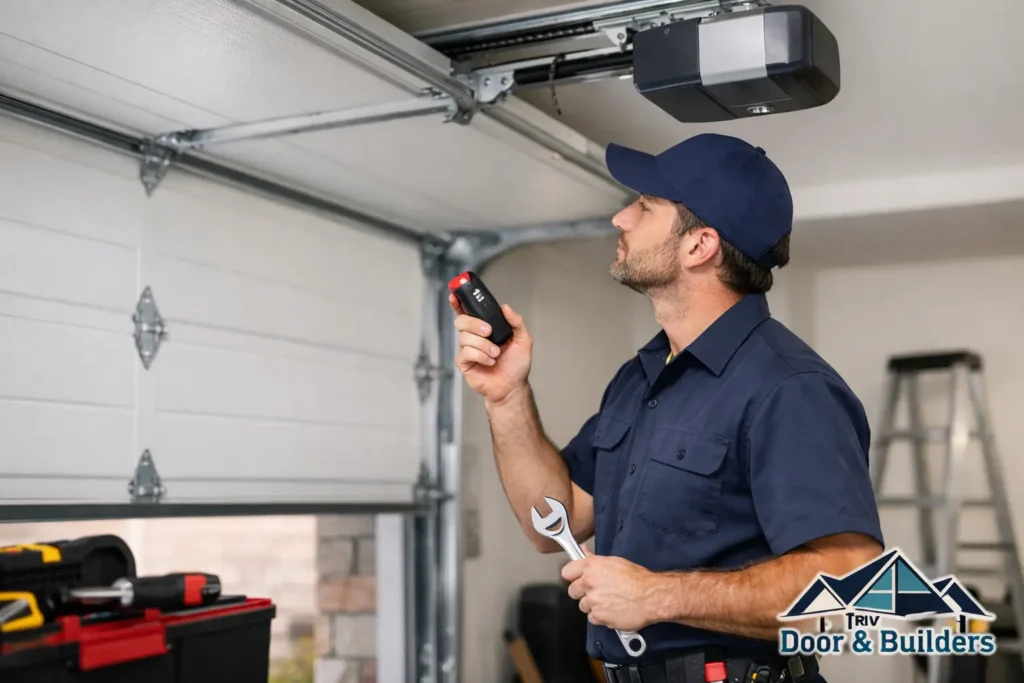
A garage door usually waits until the worst possible moment to act up. You are late for work, trying to get equipment out before rain moves in, or closing up a shop at the end of the day, and suddenly the door will not open, will not close, or sounds like it is tearing itself apart. If you are searching for garage door repair near me, you probably do not need theory. You need to know what is wrong, what is safe to check yourself, and when it is time to call someone local who can fix it without wasting your day.
For property owners in Southwestern Pennsylvania, garage door problems are not just an inconvenience. Cold weather, moisture, wind, dust, and everyday wear all take a toll on moving parts. Residential garage doors and commercial overhead doors both depend on alignment, spring tension, rollers, tracks, cables, and openers all working together. When one part starts failing, the whole system can become unreliable fast.
Why garage door problems tend to get worse quickly
A garage door is one of the largest moving parts on your property. Even a standard residential door is heavy, and many commercial or agricultural doors are much heavier. That weight is controlled by springs and hardware under significant tension. Because of that, small issues rarely stay small.
A squealing roller might seem minor for a few weeks, but if the door starts dragging in the track, the opener can strain. If the opener keeps trying to force movement, it can wear out gears, loosen brackets, or throw the door out of alignment. What could have been a straightforward service call turns into a larger repair.
That is one reason a local, experienced repair company matters. Good service is not just about replacing a broken part. It is about spotting the wear pattern behind the failure and fixing the cause, not just the symptom.
Common reasons people search for garage door repair near me
Most service calls fall into a few familiar categories, although the exact repair depends on the age of the door, the size of the opening, and whether the issue is mechanical or electrical.
The door will not open or close fully
Sometimes this points to a misaligned sensor, a limit setting issue, or an obstruction in the track. Other times, the opener is not the real problem at all. A broken spring or damaged roller can make the opener seem dead when it is actually trying to protect itself.
If the door starts down and reverses, safety sensors may be blocked or out of line. If the door barely moves and stops, there may be a spring, cable, or track problem. These symptoms look similar from the driveway, but they are not repaired the same way.
The door is loud, jerky, or uneven
A noisy door is often the first warning sign. Grinding, popping, scraping, and banging noises usually mean something is wearing out or moving incorrectly. Rollers may be damaged, hinges may be loose, tracks may be bent, or springs may be weakening.
If one side of the door looks lower than the other, stop using it until it is checked. An uneven door can signal a cable problem or spring imbalance. Continuing to run it can make the situation worse and create a safety risk.
The remote works sometimes, but not always
Intermittent opener issues can come from weak batteries, signal interference, aging logic boards, wall control problems, or sensors that only fail under certain lighting conditions. This is where experience matters. A technician should know how to separate a bad opener from a door system that is simply resisting movement.
The spring broke
This is one of the most common major repairs and one of the least DIY-friendly. You may hear a sharp snap from the garage and then find the door suddenly too heavy to lift. Springs do not last forever, and cycle life matters. If the door has been used heavily for years, spring replacement is not unusual.
What matters is using the correct spring size and balancing the door properly after installation. A shortcut here creates more trouble later.
What you can safely check before calling
Not every garage door problem requires a major repair, but it helps to rule out a few simple issues before scheduling service.
First, look for anything blocking the photo eyes near the floor. Dirt, leaves, tools, and even spiderwebs can interfere with the sensors. Wipe the lenses gently and make sure both sensors appear aligned.
Next, check the opener power source. It sounds obvious, but outlets can trip, plugs can loosen, and breaker issues do happen. If the opener has power but does not respond normally, pay attention to whether the motor hums, the lights blink, or the door tries to move and stops.
You can also inspect the tracks visually. If you see obvious bends, loose hardware, frayed cables, or a roller off track, do not force the door. That is the point where trying to make it work usually makes the repair more expensive.
What you should not do is adjust springs, tamper with cables under tension, or disassemble major hardware without the right tools and training. There is a real difference between basic observation and risky repair.
How to choose the right local garage door repair company
When people type garage door repair near me, they are often looking for speed. That makes sense. But speed alone is not enough if the job is done poorly.
A good local company should be able to explain the issue in plain language, tell you whether a repair or replacement makes more financial sense, and work on both the immediate problem and the overall condition of the system. You want practical recommendations, not pressure.
It also helps to work with a company that understands the broader needs of local property owners. In this region, many customers are not dealing with a simple suburban garage alone. They may have detached garages, workshops, farm buildings, storage structures, or commercial spaces with overhead doors that get hard daily use. The right repair team should be comfortable in all of those settings.
That is where local knowledge matters. Weather in Western and Southwestern Pennsylvania can be rough on doors and hardware, and building use varies a lot from one property to the next. A repair approach that works in a light-use residential setting may not hold up in an equipment shed or service building.
Repair or replace? It depends on the door
Not every failing garage door should be repaired indefinitely. Sometimes a targeted repair is absolutely the right move. If the door is structurally sound and the issue is isolated to springs, rollers, sensors, or the opener, repair is often the most cost-effective path.
But if the door has repeated breakdowns, severe rust, track damage, panel deterioration, or outdated hardware, replacement may be the smarter investment. The same is true when parts are no longer easy to source or when the door no longer fits the needs of the property.
For example, a homeowner may want quieter operation and better curb appeal, while a business owner may need a more durable commercial door with reliable daily performance. The answer is not always the cheapest short-term fix. It is the option that gives you dependable service without constant callbacks.
Why local service still matters
There is a difference between calling a national dispatch line and working with a company that knows the area, understands the buildings, and plans to be here after the job is done. Local service tends to be more straightforward. You are talking to people who know the region, know the weather, and know that reputation still matters.
That is one reason many property owners prefer companies like Tri County Door & Builders. The value is not just in showing up. It is in giving honest advice, offering dependable repair and installation support, and helping customers choose what makes sense for the building they actually have.
If you are comparing providers, look for experience, clear communication, and a practical mindset. The best garage door repair is not flashy. It is accurate, safe, and built to last.
When to make the call
If your door is stuck, crooked, unusually loud, slow to respond, or showing signs of worn cables or broken springs, it is time to stop guessing. A garage door system can fail gradually, but it can also fail all at once. Waiting too long often turns a manageable repair into a more expensive one.
The right next step is simple. Pay attention to what the door is doing, avoid forcing it, and get it checked by someone who knows the difference between a quick fix and a lasting repair. When your garage door works the way it should, you stop thinking about it – and that is exactly the point.