




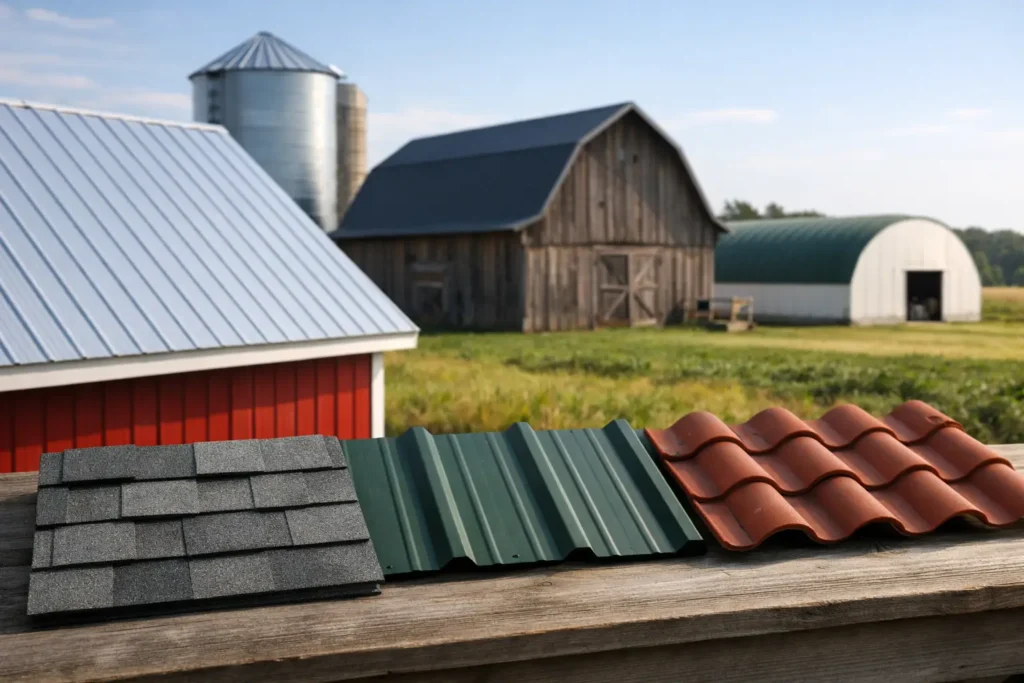
A farm roof usually gets judged on the worst day of the year, not the best one. Heavy snow, hard wind, driving rain, summer heat, and constant use all expose weak materials fast. That is why choosing the best roofing materials for farm buildings is less about appearances and more about service life, maintenance, and how the building is actually used.
A hay barn, equipment shed, horse stable, poultry house, and workshop do not all ask the same thing from a roof. Some need better moisture control. Some need stronger impact resistance. Some need the lowest upfront cost on a large footprint. The right answer depends on your structure, your budget, and the kind of weather your roof will face year after year.
What matters most in farm building roofing
Farm buildings work harder than many residential structures. They often have wide spans, simpler framing, more exposure to open wind, and more demanding interior conditions. Condensation can be a real issue in livestock and storage buildings. So can ventilation, corrosion, and the weight of snow.
For most property owners, the decision comes down to five things: upfront cost, expected lifespan, maintenance needs, structural load, and weather performance. A cheap roof that needs frequent repair is not a bargain. A premium roof that outlasts the building may not be necessary for every application either. The best value sits in the middle of those trade-offs.
Best roofing materials for farm buildings by use case
Metal roofing
For many farms, metal is the leading choice, and for good reason. It handles large roof areas well, sheds rain and snow efficiently, and offers long service life with relatively low maintenance. Panels are also a practical fit for pole buildings, equipment sheds, workshops, and general agricultural storage.
In Southwestern Pennsylvania, metal roofing makes sense because it stands up well to freeze-thaw cycles, wet weather, and snow loads when the roof system is designed correctly. It is also easier to install on many agricultural structures than some heavier materials. That can help control labor costs on large buildings.
The main trade-offs are noise, condensation, and potential denting, depending on panel type and gauge. Those issues can usually be managed with proper underlayment, insulation, and panel selection. A thinner, lower-cost panel may save money at the start, but heavier-gauge metal often pays off on buildings exposed to wind, branches, and long-term wear.
If you want one material that covers the broadest range of farm uses, metal is often the safest recommendation.
Asphalt shingles
Asphalt shingles can be a smart option for certain farm buildings, especially when the structure is more residential in style or has a steeper roof pitch. They are common on farm offices, detached garages, smaller workshops, and barndominium-style buildings where appearance matters along with performance.
Shingles usually cost less upfront than many premium roofing systems and are familiar to most property owners. Repairs can be straightforward, and product choices are wide. For buildings that are heated, insulated, or used as living or mixed-use space, shingles may fit the project better than exposed fastener metal.
That said, shingles are not always the best answer for large agricultural roofs. They generally do not make as much sense on low-slope buildings or wide-span utility structures. They can also be more vulnerable to wind damage if the wrong product is chosen or if installation is poor. For the right farm building, though, modern architectural shingles from established brands can offer dependable protection and good value.
Corrugated and exposed fastener panels
This category is often what people picture first when they think of a farm roof. Corrugated and other exposed fastener metal panels are practical, affordable, and widely used on barns, machine sheds, and storage buildings.
Their biggest advantage is cost. If you need to cover a large roof area without pushing the budget too far, this style of metal roofing is hard to ignore. It is also proven in agricultural settings and easy to match with many pole building designs.
The drawback is that exposed fasteners create more long-term maintenance points than concealed fastener systems. Washers can age, fasteners can loosen, and periodic inspection matters. That does not make the system bad. It just means you should expect some maintenance over time, especially on older buildings or roofs with high sun and weather exposure.
Standing seam metal roofing
Standing seam is a premium metal roofing option that offers a cleaner look and stronger long-term weather performance than many exposed fastener systems. Because the fasteners are concealed, there are fewer direct penetration points exposed to the weather. That usually means better leak resistance over the long haul.
This material is often chosen for higher-end agricultural buildings, commercial-farm hybrids, barndominiums, and buildings where long service life is a top priority. It also performs well in areas where snow and water management matter.
The trade-off is price. Standing seam generally costs more than exposed fastener panels, both in materials and installation. For some farm buildings, that extra investment is justified. For a basic storage shed, it may be more roof than the project really needs.
Rubber and membrane roofing for low-slope buildings
Not every farm building has a steep roof. Some agricultural and utility structures have low-slope sections where metal panels or shingles are not the best fit. In those cases, membrane systems such as EPDM or TPO may be the right choice.
These roofs are more common on commercial-style farm buildings, processing areas, attached service spaces, or additions with flatter designs. When installed correctly, they can provide solid waterproofing over low-slope surfaces.
The catch is that these systems are more specialized. Material choice, seam quality, drainage design, and proper installation matter a great deal. If your farm building has a low-slope roof, the conversation needs to focus less on the cheapest material and more on building design and drainage.
How to choose the right farm roof
Start with the building’s purpose
A livestock building has different roofing demands than a hay barn. Moisture, ammonia exposure, ventilation, and interior temperature swings can all affect material performance. A machinery building may need the simplest, toughest roof for the money. A farm retail space or office may need a more finished appearance.
If the building stores valuable equipment, feed, or inventory, a longer-lasting roof usually makes more financial sense. If it is a basic shelter with a limited service expectation, a lower-cost material may be the smarter move.
Factor in roof pitch and structure
Roof slope limits your options. Shingles need enough pitch to shed water properly. Some metal systems are more forgiving than others, but low-slope applications still need careful planning. Structural capacity matters too. Heavier roofing materials can place more demand on framing, especially on older buildings.
That is one reason farm roofing decisions should not be made by material price alone. The roof has to match the structure underneath it.
Think about maintenance before you buy
A lot of farm owners are willing to do maintenance, but few want constant roof repairs. If the building is hard to access or full of animals, feed, or expensive equipment, low-maintenance roofing becomes more valuable.
Metal roofing often wins here, but not every metal system is equal. Exposed fastener roofs are dependable, though they benefit from periodic attention. Standing seam usually asks less of you over time. Shingles fall somewhere in the middle, depending on product quality and building design.
Do not ignore insulation and condensation control
Roofing material is only part of the system. On many farm buildings, insulation and condensation control are just as important as the panels or shingles on top. A strong roof can still create problems if warm interior air meets a cold roof surface and moisture starts to build.
This is especially relevant in buildings that house animals, protect tools, or store products that do not handle damp conditions well. In many cases, improving the full roof assembly delivers better long-term performance than upgrading the outer material alone.
Cost versus lifespan
The cheapest roof per square foot is not always the lowest-cost roof over twenty years. If a material needs more repairs, has a shorter lifespan, or creates moisture issues inside the building, the true cost rises quickly.
For many agricultural owners, exposed fastener metal offers the best balance of cost and durability. Standing seam moves the needle toward long-term performance but at a higher initial investment. Asphalt shingles can be a practical fit for smaller or more residential-style farm buildings. Membrane systems are mainly a function-driven choice for low-slope conditions.
This is where local guidance matters. A roof that performs well in one region may not be the best fit in another. Snow load, wind exposure, humidity, and seasonal temperature swings all affect what value really looks like.
A practical recommendation for most farm owners
If you are choosing among the best roofing materials for farm buildings, start by assuming metal will be the front-runner, then test that against your actual building. For large barns, pole buildings, equipment storage, and utility structures, metal usually provides the best mix of durability, weather resistance, and long-term affordability. For mixed-use farm buildings or more residential-looking structures, shingles may be the better fit. For low-slope sections, membrane roofing deserves serious consideration.
At Tri County Door & Builders, this is the kind of decision we encourage customers to make carefully, not quickly. The right roof is the one that fits the building, the workload, and the budget without leaving you with avoidable problems a few seasons later.
A farm roof does not need to be fancy. It needs to keep working when the weather turns, the schedule is full, and the building underneath it still has a job to do.