




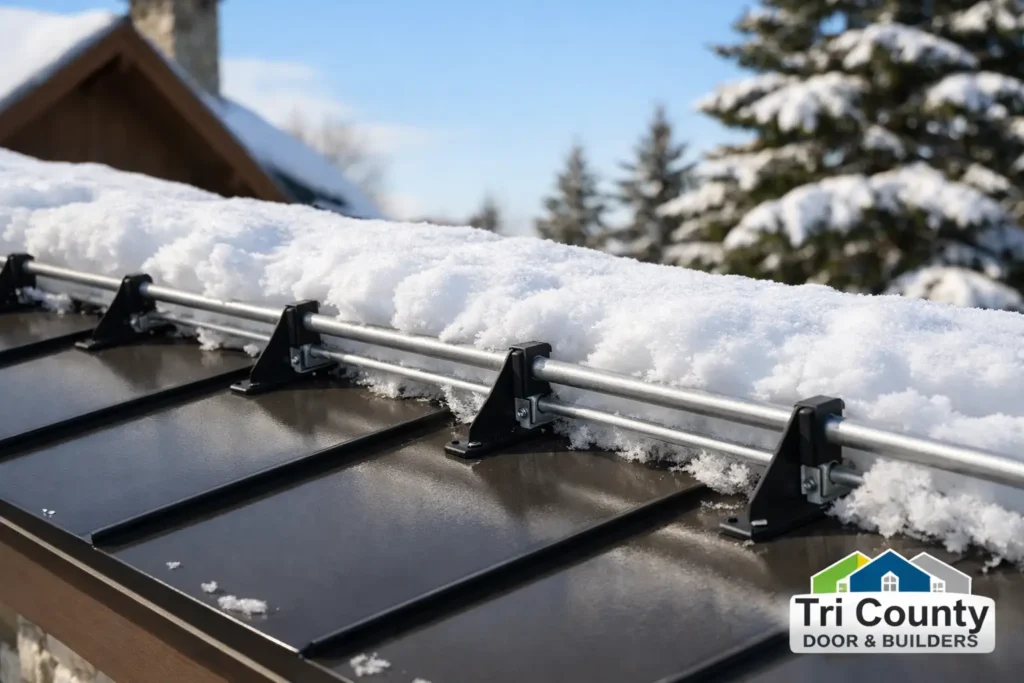
A heavy snow looks harmless right up until it lets go all at once. If you own a home, barn, garage, or commercial building with a slick roof surface, roof snow retention systems can prevent that sudden slide from damaging gutters, crushing equipment, blocking entries, or creating a serious safety risk below.
In our part of Pennsylvania, that risk is not theoretical. A few inches of snow may sit for days, then a temperature swing or afternoon sun turns the roof into a launch ramp. Metal roofing is especially prone to snow shedding because the surface is smooth and durable by design. That is one reason snow retention should be part of the roof conversation early, not an afterthought after the first hard winter.
What roof snow retention systems actually do
Roof snow retention systems are designed to control the release of snow and ice. Rather than allowing the entire snow pack to slide off in one sheet, they hold it in place or slow it down so it melts and comes off in a more manageable way.
That distinction matters. The goal is usually not to keep every bit of snow on the roof forever. The goal is controlled movement. A well-planned system reduces the chance of sudden dumps over walkways, door openings, loading areas, drive lanes, lower roof sections, and landscaping.
This is especially useful on metal roofs, where snow can break free fast. Shingle roofs may also benefit in certain designs, but the conversation is different because the roof surface, pitch, and attachment method all change what is appropriate.
Why they matter more than many owners realize
Most people think first about people slipping on snow that falls from the roof edge. That is part of it, but the bigger issue is often property protection.
A large sheet of sliding snow can tear off gutters, damage snow guards that were undersized or poorly installed, bend light fixtures, hit outdoor HVAC equipment, and pile against garage doors or service doors. On agricultural and commercial properties, it can also interfere with access and daily operations. If your building has entrances that people use every day, or if vehicles park close to the structure, the risk goes up.
There is also a design side to this. Some roofs naturally dump snow away from traffic areas. Others shed directly over front walks, side entries, overhead doors, and lower roof valleys. In those cases, snow retention is less of an upgrade and more of a practical safety measure.
The main types of roof snow retention systems
There is no single setup that works for every building. The right choice depends on roof material, panel profile, slope, building use, and the amount of snow your area typically sees.
Pad-style snow guards
These are individual pieces spaced in a pattern across the roof. They are common on many residential projects because they can blend in well and work on specific roof types. Their job is to break up the snow pack and reduce the chance of one large release.
They can work well, but layout matters. Too few guards, poor spacing, or the wrong attachment method can lead to failure. They are not something to treat like a simple accessory.
Bar-style systems
These use one or more horizontal bars mounted near the roof edge or in multiple rows up the slope. Bar systems are often used where snow loads are heavier or where the consequences of sliding snow are more serious.
On many metal roofs, especially larger residential, agricultural, and commercial buildings, this approach provides more continuous holding power than individual guards alone. It is often the better fit when protecting entries, pedestrian zones, or equipment.
Fence-style systems
These are similar in purpose to bar systems but use a taller, more rigid profile to hold back snow. They are often seen where appearance, performance, or a specific engineering requirement points in that direction.
The trade-off is visibility and cost. Some owners like the clean, purposeful look. Others prefer a lower-profile system.
Where snow retention makes the most sense
Not every roof needs it everywhere. In fact, one of the most common mistakes is assuming the whole roof should be treated the same way.
The highest-priority areas are usually above entrances, sidewalks, decks, garage doors, service doors, loading zones, and any place where people regularly walk or work. Lower roof sections also deserve attention because snow dropping from an upper roof can overload or damage the section below.
For barns, workshops, and outbuildings, the concern may be less about foot traffic and more about protecting door openings, feed areas, equipment pads, or paths used in winter. For commercial buildings, code considerations, liability concerns, and customer access often push snow retention higher on the priority list.
When roof pitch and material change the answer
This is where experience matters. A steep metal roof behaves differently from a low-slope membrane roof or an architectural shingle roof. Even among metal roofs, standing seam and exposed-fastener panels may require different products and attachment methods.
Standing seam roofs often allow clamp-on snow retention options that do not penetrate the panel in the same way other systems might. That can be a major advantage when preserving roof performance. On exposed-fastener metal roofs, the design has to account for fastening strategy, panel strength, and long-term weather exposure.
Steeper roofs usually create a stronger sliding force. Smoother materials do too. That does not automatically mean you need the biggest system available, but it does mean the layout and load calculations should not be guessed at.
Common mistakes to avoid
The biggest mistake is treating snow retention like decoration. It is a load-management product. If it is installed without regard to panel type, snow load, spacing, or attachment strength, it may fail when you need it most.
Another mistake is placing retention only at the very edge of the roof. In many cases, that puts too much force in one area. Some roofs need multiple rows higher up the slope to distribute the load more effectively.
Cheap products are another problem. Saving a little on hardware does not mean much if the first major storm rips the system loose and damages the roof edge, gutters, or property below. A lower upfront cost can turn into a more expensive repair.
It is also common to overlook how snow and ice interact with gutters. If the roof is going to hold snow longer, the edge details need to make sense with the overall roof design.
New construction versus retrofit
It is always easier to plan roof snow retention systems during a new build or roof replacement. At that stage, the roof type, attachment method, and traffic patterns can all be considered together.
Retrofit installations are still common and often worthwhile, especially after a building owner has seen repeated snow slides. The key is making sure the product is compatible with the existing roof and that the attachment approach does not create new problems.
If you are already replacing a roof, that is the time to ask the question. Homeowners looking at shingle replacement, for example, may be focused on color and price, but roof design details matter too. And if you are considering a new shingle roof, promotions like Tri County Door & Builders’ 30% off Owens Corning shingles campaign can help free up budget for the right accessories and installation details instead of cutting corners.
How to choose the right system
Start with the building’s actual use. A back shed with no foot traffic below has different needs than a storefront, a heated workshop, or a home with a front walk directly under the eave.
Then look at the roof itself. Material, pitch, panel profile, rafter spacing, roof length, and regional snow conditions all affect product choice. Appearance matters too, but it should come after performance.
This is one of those decisions where local knowledge helps. Snow behavior in Southwestern Pennsylvania is shaped by freeze-thaw cycles, mixed winter precipitation, and uneven loading from drifting and sun exposure. A system that looks fine on paper may not be the best fit for the way winter actually behaves here.
Is snow retention always necessary?
No. Some buildings are positioned so snow can shed into safe, open areas. Some roof types and slopes reduce the concern. And in some cases, selective retention over critical areas is more sensible than a full-roof approach.
That is why a no-nonsense evaluation matters more than a sales pitch. The right answer might be a bar system over entry points, a guard pattern above a lower roof, or no retention at all on certain sections. Good planning is about matching the system to the risk, not overselling hardware.
If you are building new, replacing a roof, or tired of winter snow piling up where it should not, now is the time to look at it closely. A controlled roof does more than protect the building – it makes the space around it safer and easier to use all season long.