




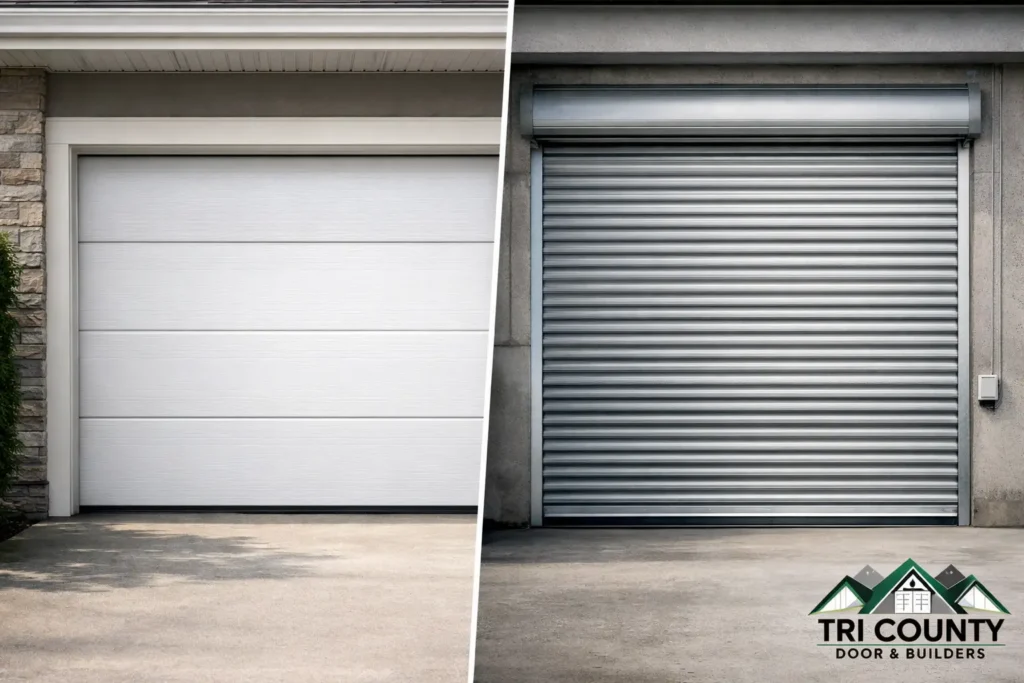
If you are replacing a garage door, the wrong choice usually shows up later – in higher heating bills, lost headroom, louder operation, or a door that does not fit how you actually use the building. When homeowners and property owners compare sectional garage doors vs roll up, they are usually not choosing between a good option and a bad one. They are choosing between two designs built for different priorities.
That distinction matters whether you are upgrading a home garage, outfitting a workshop, or planning a door for a farm or commercial building. The best fit depends on your opening size, available interior space, insulation needs, security expectations, and budget.
Sectional garage doors vs roll up: the basic difference
A sectional garage door is made of large horizontal panels hinged together. As the door opens, those panels move up on tracks and rest overhead, parallel to the ceiling. This is the style most homeowners picture when they think of a standard garage door.
A roll up door is built from narrow slats that coil into a drum above the opening. Instead of running back along ceiling tracks, the curtain wraps into a compact roll. That design is common on storage units, service bays, warehouses, and agricultural buildings, but it can also work in some residential settings.
On paper, both doors open vertically and save driveway space compared to swing-out designs. In practice, they behave very differently once you factor in insulation, appearance, maintenance, and how the building is used every day.
Where sectional doors usually make more sense
For most homes, sectional doors are the more natural fit. They tend to offer better curb appeal, more style choices, and stronger insulation options. If your garage is attached to the house, used as a workshop, or sits under a finished room, those points become hard to ignore.
A sectional door also gives you more flexibility in design. Homeowners can choose raised panel, carriage-house, flush, steel, wood-look, or insulated models in a range of colors and window layouts. If appearance matters from the street, sectional doors simply give you more room to match the home.
They also tend to run quieter. That matters if bedrooms sit above the garage or if family members leave at different hours. A quality sectional system with the right opener can be noticeably smoother and less disruptive than a basic roll up setup.
Insulation is another major reason sectional doors are often preferred for residential use. Many are available with higher R-values and tighter seals around the perimeter. In Western Pennsylvania, where winters are cold and shoulder seasons can swing from damp to chilly fast, that added thermal performance can make the garage more usable and help protect what is stored inside.
Where roll up doors have the advantage
Roll up doors shine when durability, simplicity, and efficient use of space matter more than appearance. Because the door coils above the opening, it does not require the same overhead track layout as a sectional system. That can be a real benefit in buildings where ceiling space is needed for lights, lifts, shelving, or equipment.
This is one reason roll up doors are often chosen for commercial buildings, pole barns, storage facilities, and agricultural structures. They are straightforward, compact, and well suited for frequent use in practical settings.
They also make sense when the opening is large or the environment is rougher. A property owner who needs a dependable door on a workshop, equipment shed, or service building may care far more about function than decorative options. In that case, a roll up door can be the better investment.
Another factor is exposure. In work environments where dust, debris, and heavy use are common, many owners appreciate the simpler, rugged nature of a roll up design. That does not mean they are maintenance-free, but they are often selected because they are built with utility first.
Cost is not just about the price tag
When people ask which option is cheaper, the honest answer is that it depends on the size of the opening, the gauge of the steel, insulation level, finish, hardware quality, and installation conditions.
For a typical home garage, a standard sectional door may offer better overall value because there are more product options across different price points. You can often choose a model that fits both your budget and your home without overbuilding the project.
Roll up doors can be cost-effective in the right application, especially on utility buildings where appearance is less of a factor. But specialized sizes, heavier-duty construction, and commercial-grade features can push pricing up quickly.
It is also worth thinking beyond purchase cost. A less insulated door may save money upfront but cost more in energy loss. A door that limits ceiling use may affect how you store tools or operate equipment. Good value comes from matching the door to the building, not just choosing the lower estimate.
Insulation and weather performance
This is where usage matters most
If the garage is attached to the home, insulation should move much higher on your priority list. Sectional doors usually offer stronger insulation packages and better sealing at the joints. That can help reduce drafts, temperature swings, and condensation issues.
For detached garages, barns, and storage buildings, insulation may still matter, but not always at the same level. If the space is unconditioned and mainly used for parking or equipment storage, a non-insulated or lightly insulated roll up door may be perfectly reasonable.
Still, local weather should not be ignored. In areas like Fayette, Somerset, and Westmoreland counties, snow, wind, and cold temperatures can expose the weak points in any door system. A well-fitted, properly installed door matters just as much as the product itself.
Space and clearance considerations
One of the biggest practical differences in sectional garage doors vs roll up comes down to what happens above the opening.
A sectional door needs overhead track space as the panels travel back into the garage. That is not usually a problem in a standard residential garage, but it can interfere with lighting, storage racks, or specialty equipment.
A roll up door stores in a coil above the opening, which keeps more of the ceiling area open. If you need uninterrupted overhead space inside the building, that can be a major advantage. On the other hand, the drum itself requires room at the header, so the opening must be evaluated carefully.
This is one of those areas where measurements on paper do not always tell the full story. The right answer depends on your framing, ceiling height, obstructions, and how you plan to use the building after the door is installed.
Security, maintenance, and lifespan
Both styles can provide solid security when built well and installed correctly. The bigger differences usually come down to hardware quality, material thickness, locking features, and how heavily the door will be used.
Sectional doors have more moving parts across tracks, rollers, hinges, and spring systems, but that does not make them a poor choice. It just means routine maintenance matters. Roll up doors also require upkeep, especially in high-cycle settings, but their simpler form can appeal to owners who want a work-focused solution.
As for lifespan, neither style automatically wins. A quality sectional door on a home can last for many years with proper service. A properly specified roll up door can also hold up extremely well in demanding environments. The key is choosing the right grade for the job instead of assuming one category is always tougher.
Which garage door is best for your property?
If your priority is appearance, insulation, quieter performance, and a better fit for an attached or front-facing residential garage, a sectional door is usually the smarter choice.
If your priority is maximizing ceiling space, handling a more utilitarian building, or choosing a compact and durable door for a workshop, barn, storage building, or commercial opening, a roll up door may be the better fit.
There are gray areas, of course. Some homeowners want a roll up door for a detached garage because they value function over style. Some commercial owners choose sectional doors because insulation and appearance matter for customer-facing buildings. That is why the best recommendation starts with the building and the way you use it.
At Tri County Door & Builders, that is usually where the conversation begins – not with a one-size-fits-all answer, but with what will hold up, perform well, and make sense for the property over time.
If you are weighing sectional against roll up, the smartest next step is not guessing from photos. It is looking at the opening, the building layout, and the daily use of the space so the door works well long after installation day.