




A commercial door that hesitates at 7:30 a.m. can hold up deliveries, frustrate employees, and leave a building exposed when it should be secure. This commercial door opener review focuses on what property owners, contractors, and facility managers should evaluate before selecting equipment for a shop, warehouse, farm building, service bay, or multi-door operation.
The best opener is not automatically the biggest motor or the lowest-priced unit. It is the operator that matches the door’s weight, movement, usage level, environment, and safety requirements – then receives proper installation and service. A light-duty operator placed on a busy loading door may work for a while, but it will not be a good value when downtime and repairs start adding up.
Commercial Door Opener Review: Start With the Door
Commercial openers are often discussed as though they are interchangeable. They are not. The door itself determines much of the decision. A sectional overhead door in a vehicle service bay has different operating needs than a rolling steel door at a storage facility or a large agricultural door used several times a day.
Start with the door’s size, weight, track arrangement, springs, and condition. An opener cannot correct a door that binds in the tracks, has worn rollers, or relies on improperly balanced springs. In fact, using a new operator on a poorly maintained door can shorten the operator’s life because the motor is forced to work harder on every cycle.
The number of daily cycles matters just as much. A door opened twice each morning and closed at night does not need the same equipment as a door that moves throughout the day for staff, freight, customers, or equipment. Ask for an operator rated for the actual workload, not the workload you hope the building will have forever. If a business is expanding, choosing a higher-duty unit upfront can prevent an early replacement.
Understanding Commercial Opener Types
The right drive style depends on available space, door construction, access needs, and the level of use. Each type has a place, and no single design is best for every facility.
Trolley Operators
A trolley operator is commonly used on sectional doors where the opener is mounted overhead and pulls the door along the horizontal tracks. This setup can be a practical choice for many standard commercial garage doors, particularly when there is adequate ceiling clearance.
Trolley systems are familiar and effective, but the overhead space must be clear. HVAC equipment, lighting, storage racks, sprinklers, or low ceilings can make another mounting style a better fit. The rail and moving trolley also need periodic inspection, especially in busy service environments where vibration and dust are common.
Jackshaft Operators
A jackshaft operator mounts on the wall beside the door and turns the door shaft directly. This style can free up ceiling space and is often a strong option for sectional doors in shops, fire stations, warehouses, and buildings with high or obstructed ceilings.
Because the operator works directly with the torsion shaft, proper door balance is especially critical. A jackshaft unit may look compact, but it is not a shortcut around spring, shaft, drum, or track issues. When the door is correctly set up, this design offers clean operation and easier overhead access for lighting, storage, or other building systems.
Hoist Operators
Hoist operators are designed for heavier doors and higher-use applications. They use a chain hoist arrangement that allows manual operation when needed, which can be valuable during a power interruption or maintenance situation.
This type is often appropriate for larger sectional doors and rolling doors where weight and duty demands exceed what a standard operator should handle. It typically costs more than a lighter-duty setup, but that added capacity can be the sensible choice for a door that supports daily business operations.
Rolling Door Operators
Rolling steel and sheet doors need operators designed for their curtain, barrel, and mounting requirements. A rolling door may serve a loading area, storage unit, agricultural building, or commercial storefront opening, and its operator must be sized for the door’s weight and usage pattern.
Do not assume that an operator used on a sectional door can be adapted to a rolling door. The mechanics are different, and the safety devices, travel limits, and controls must be properly matched to the application.
What Separates a Good Operator From a Good Investment
Motor power receives attention because it is easy to compare, but horsepower is only one part of the picture. Duty rating, control quality, safety equipment, and local service support often have a bigger effect on long-term satisfaction.
A commercial operator should be rated for the door’s cycle count and expected use. A small private garage may run reliably with limited cycles, while a fleet bay, repair shop, or active warehouse needs equipment built for frequent starts and stops. Underestimating duty is one of the most common ways a seemingly affordable purchase becomes expensive.
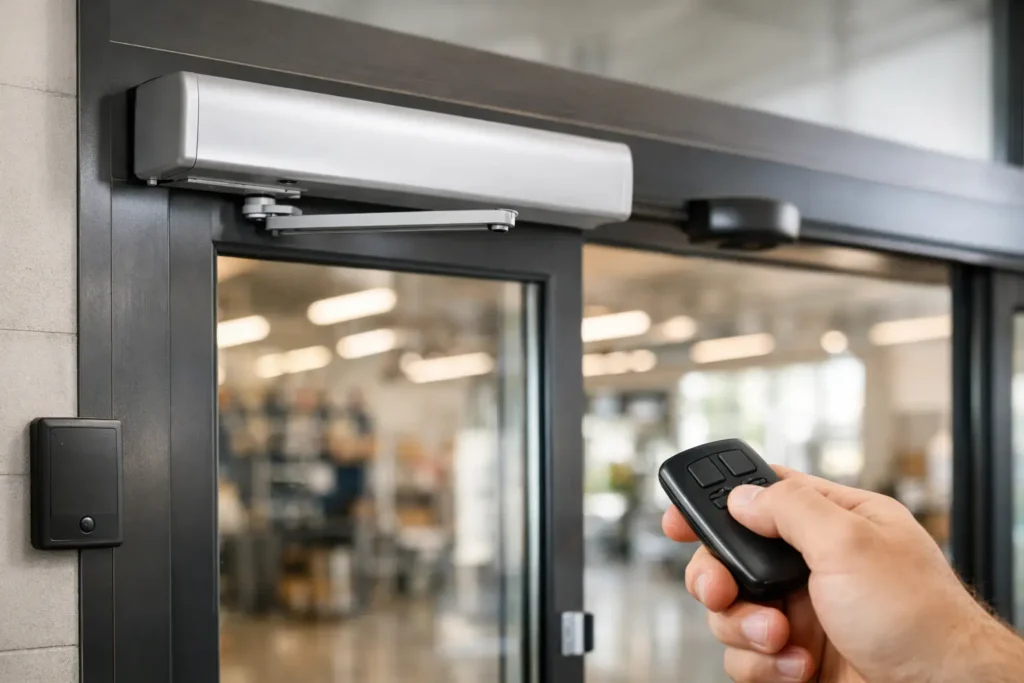
Controls deserve careful consideration. A basic wall station may be enough for a secured equipment building. A business with multiple employees, delivery activity, or restricted access may need keypads, remote controls, monitored controls, timer-to-close functions, or integration with access systems. Added controls improve convenience, but they should support how the building is actually used. More features are not automatically better if they create confusion or security concerns.
Battery backup can be worthwhile where an overhead door is necessary for vehicle access or daily operations. It is not a replacement for a generator plan at a critical facility, but it can keep a door usable through shorter outages. For many Southwestern Pennsylvania businesses, that extra capability is worth discussing before installation rather than after a storm or power issue.
Safety Features Are Not Optional Extras
A commercial door is heavy, and the people around it may include employees, customers, visitors, and delivery drivers. Proper safety equipment protects people and helps reduce the chance of damaged vehicles, equipment, and inventory.
Photo eyes are common on sectional overhead doors and reverse the door when the beam is interrupted. Depending on the application, monitored safety edges, warning devices, and other controls may also be needed. The correct setup depends on the door type, location, use, and applicable requirements.
Safety devices only work when they are aligned, connected, and tested. A photo eye can be knocked out of position by a pallet, broom, vehicle bumper, or ordinary building activity. Make testing the door’s reversing system part of routine facility maintenance. If the operator reverses unexpectedly, fails to close, or closes without responding correctly to an obstruction test, schedule service instead of disabling the safety equipment.
Installation Quality Affects Every Day of Operation
Commercial opener installation is not simply a matter of hanging a motor and plugging it in. The door must be balanced, tracks and rollers inspected, mounting points secured, limits set accurately, and safety components tested. Electrical requirements also need to be confirmed before work begins, particularly for larger operators that may require a specific voltage or dedicated circuit.
A careful installer will also consider practical details that are easy to miss during a quick quote. Can the wall control be reached safely? Will a moving door interfere with equipment or parked vehicles? Is there enough room for the operator? Can staff use the manual release or hoist when necessary? These questions make a difference after the installation crew leaves.
For property owners managing several openings, standardizing controls and maintenance practices can save time. It does not mean every door must use the exact same operator. It means staff should know how each door works, who can access it, and what warning signs require a service call.
Maintenance Protects Uptime
Commercial doors and operators work together. Neglect one, and the other pays the price. A practical maintenance visit should include inspection of springs, cables, drums, rollers, hinges, tracks, bearings, hardware, travel limits, safety devices, and operator function.
Between professional inspections, building staff can watch for changes in normal operation. New grinding sounds, jerky travel, delayed movement, a crooked door, frayed cables, or a door that will not stay open are all reasons to stop using the system and arrange service. Do not attempt spring or cable repairs without the right tools and training. Those components are under significant tension.
Lubrication can help, but it is not the cure for a mechanical issue. Applying more lubricant to a worn roller or misaligned track may quiet the symptom briefly while the actual problem continues.
How to Make the Final Choice
Before approving an operator, provide accurate information about the door, building, and daily use. A dependable recommendation should account for door dimensions, construction, cycle frequency, available clearance, electrical service, desired access controls, and any need for backup power or special safety devices.
Price should be considered honestly. A lighter commercial operator can be appropriate for a lower-use door and may be the right way to control project costs. But a high-cycle operation should not be equipped as though it were a weekend garage. The cost of a failed door often includes lost work time, emergency service, security concerns, and unhappy customers.
Tri County Door & Builders helps property owners across Southwestern Pennsylvania evaluate garage door and operator needs with practical guidance, installation support, and repair service when it matters. The right commercial opener should feel uneventful: the door opens when work begins, closes securely when the day ends, and keeps doing its job without becoming the day’s problem.